Ionizable Lipid Nanoparticle Formulation
Biopathio's core LNP platform is built on ionizable lipid chemistry specifically optimized for CNS delivery — not repurposed from hepatic formulations. Every parameter, from pKa to PEG density, is selected for endosomal escape in neural tissue.
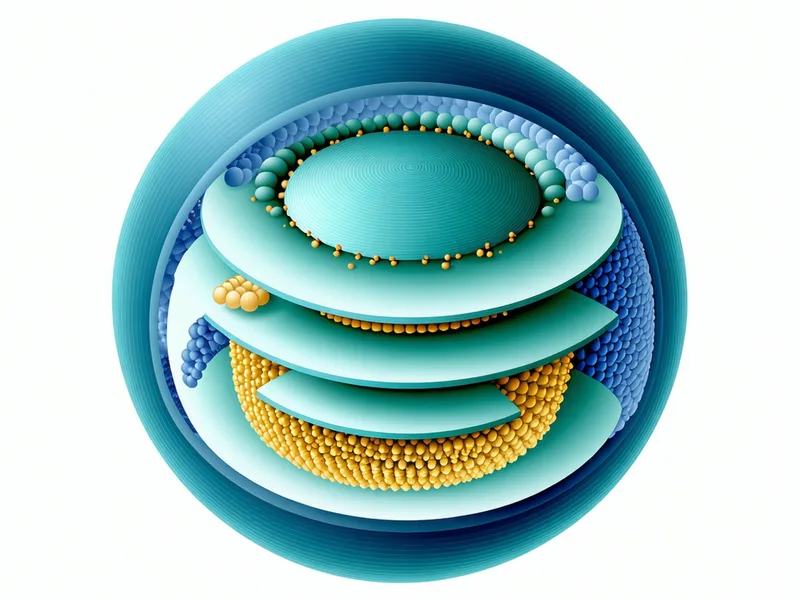
Ionizable Lipid pKa Selection and Optimization
The ionizable lipid component is the critical determinant of endosomal escape efficiency. In hepatic LNP delivery, pKa values in the 6.2–6.5 range take advantage of ApoE-mediated uptake by hepatocytes. CNS neurons do not express ApoE at the same levels, and the endosomal pH gradient in neural cells differs meaningfully.
Biopathio's ionizable lipid candidates are screened at pKa 5.8–6.3, targeting the endosomal acidification profile of cortical neurons and astrocytes rather than hepatocytes. The optimal pKa window shifts the protonation state to facilitate membrane destabilization at the pH of late endosomes in neural cells.
Helper Lipid Composition
The four-component LNP formulation includes ionizable lipid, helper phospholipid (DSPC), cholesterol, and PEG-lipid. The molar ratios are optimized empirically for CNS applications:
- DSPC (distearoylphosphatidylcholine): 10–12 mol% — provides structural stability and reduces fusogenicity at physiological pH
- Cholesterol: 38–42 mol% — modulates membrane rigidity and promotes endosomal escape through membrane fusion
- PEG-lipid (DMG-PEG2000): 1.5–2.5 mol% — controls particle size and reduces non-specific protein adsorption; higher PEG density used for CNS surface engineering
- Ionizable lipid: 45–50 mol% — primary determinant of encapsulation and release kinetics
Characterization Panel
Every Biopathio formulation batch undergoes a full characterization panel before use in any downstream biology experiment. Standard hepatic LNP QC (DLS + EE) is insufficient for CNS delivery work.
| Parameter | Method | Biopathio CNS-LNP | Specification |
|---|---|---|---|
| Particle diameter (z-average) | DLS | 83.2 ± 4.1 nm | 70–100 nm |
| Polydispersity index (PDI) | DLS | 0.12 ± 0.03 | < 0.20 |
| Encapsulation efficiency (sgRNA) | RiboGreen assay | 79.3 ± 3.2 % | > 70% |
| Zeta potential | ELS | -4.8 ± 1.5 mV | -10 to +5 mV |
| Morphology | cryo-TEM | Electron-dense, spherical | Unilamellar spheres |
| In vitro BBB cell uptake | hCMEC/D3 fluorescence | 62 ± 8 % | > 40% at 4h |
Manufacturing Process
Biopathio's formulation process uses microfluidic mixing (NanoAssemblr platform or equivalent) at controlled flow rate ratios (aqueous:organic 3:1 v/v) followed by tangential flow filtration (TFF) for buffer exchange and concentration. Key process parameters:
- Mixing temperature: 4°C aqueous phase, ambient organic phase
- Total flow rate: 12 mL/min (lab-scale); scalable to 100 mL/min without size shift
- Nucleic acid:lipid ratio: 1:10–1:20 (w:w), optimized per cargo type
- Buffer exchange: PBS pH 7.4 via TFF (100 kDa MWCO hollow-fiber membrane)
Storage Stability
CNS-targeted LNPs are sensitive to freeze-thaw cycles due to surface ligand disruption. Biopathio has evaluated storage conditions across multiple formats:
| Storage Condition | Duration Tested | Size Change | EE Retention |
|---|---|---|---|
| 4°C (liquid) | 30 days | < 5 nm shift | > 95% |
| -80°C (10% sucrose cryoprotectant) | 90 days | < 8 nm shift | > 90% |
| Lyophilized (trehalose matrix) | 60 days (reconstituted) | < 12 nm shift | > 85% |
Evaluate our LNP platform for your payload
Custom formulation feasibility studies available for defined nucleic acid cargoes.